



Markets do remain overvalued across the
investment part of the economy and we may
see normalisation in some of these segments.
We remain bullish on equities
from a medium to long term
perspective.
Investors are suggested to have their
asset allocation plan based on one's risk
appetite and future goals in life.
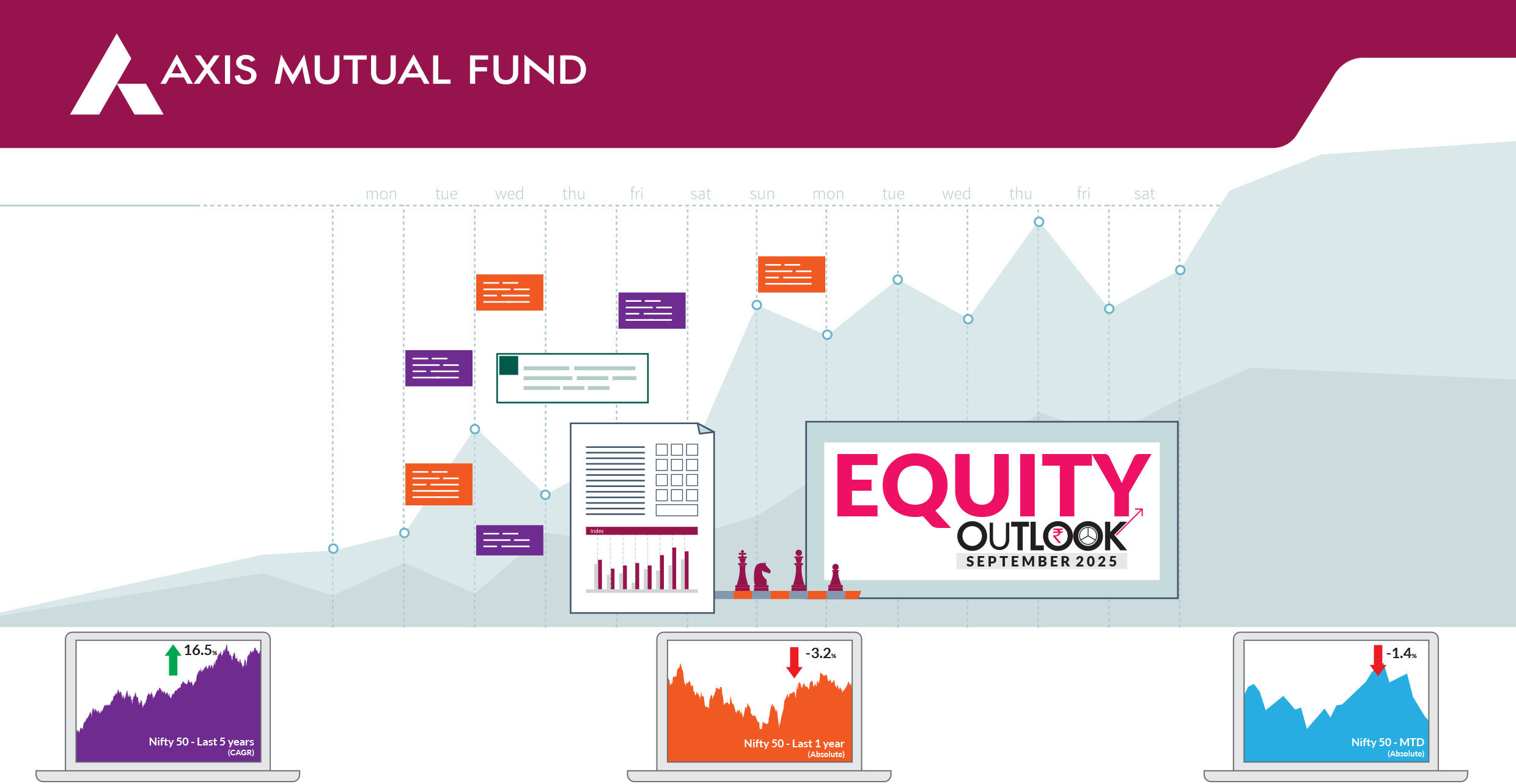
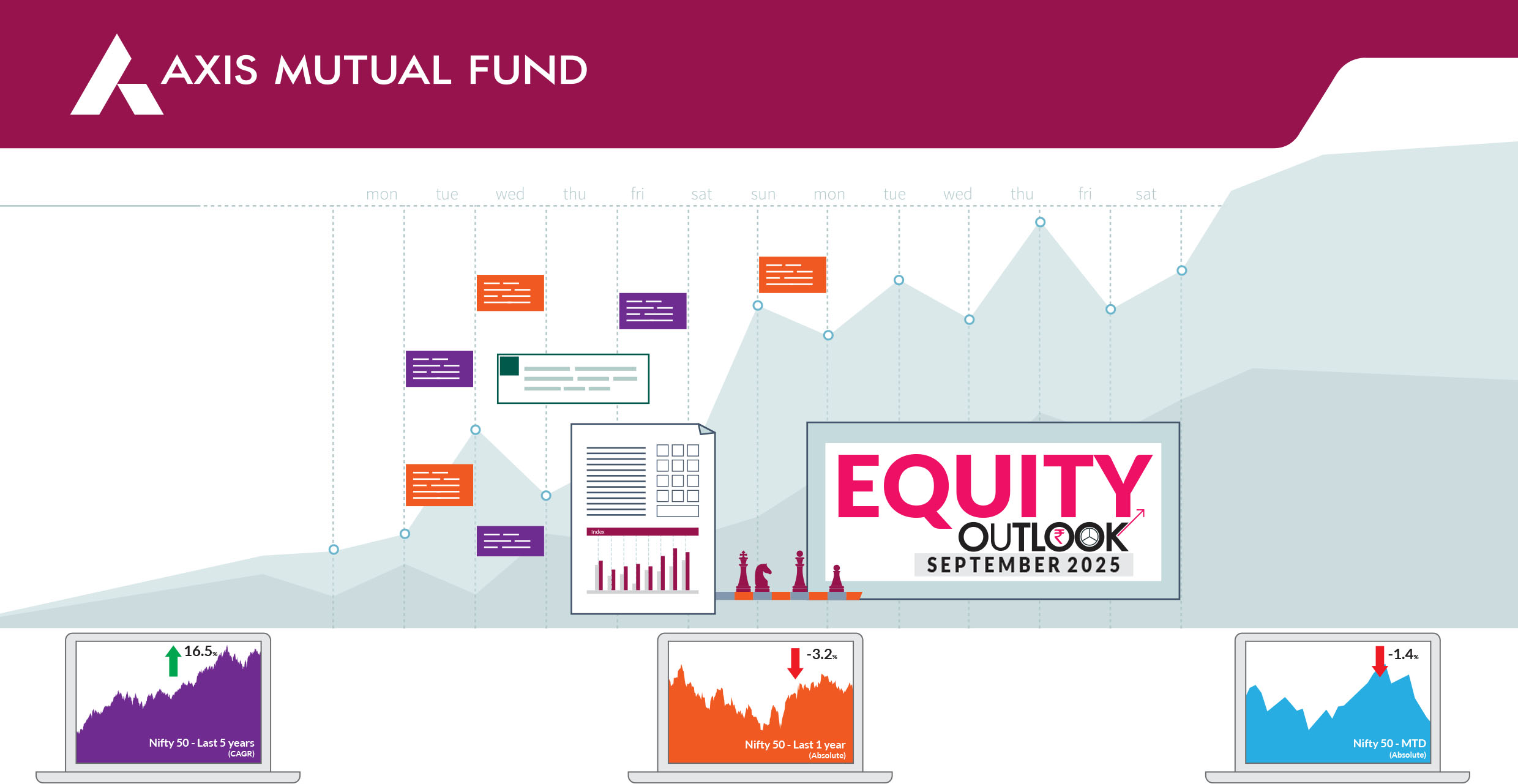
 Indian equities continued to remain impacted by the evolving tariff scenario particularly with the additional 25% tariffs kicking in. The BSE Sensex and Nifty 50 ended the month with declines of 1.7% and 1.4%, respectively. The mid and small-cap indices underperformed, with the NSE Midcap 100 declining by 2.9% and NSE Smallcap 100 falling by 4.1%, reflecting heightened caution among investors. Consumption-oriented sectors saw a rally on the government's plan for rationalization of GST. Auto and consumer durables sectors were up 5.8% and 2%, respectively. Oil & gas, power and realty were down 4.7%,4.6% and 4.5%, respectively. Globally, US equities remained buoyant, continuing with their gains for the fourth consecutive month; the S&P 500 touched lifetime highs, supported by continued strength from mega cap stocks. Meanwhile, Foreign Portfolio Investors (FPIs) remained net sellers in August, pulling out US$4 bn while Domestic Institutional Investors (DIIs) remained supportive with US$9.5 bn in equity purchases. Year to date, FPI outflows total US$13.6 bn while the DIIs bought to the tune of US$58 bn. On the macro front, the Reserve Bank of India kept interest rates unchanged, GDP data came in better than expected and S&P Global upgraded India's sovereign rating from BBBto BBB while maintaining a stable outlook. |
 Key highlights of the month GST rationalization: During the month, the government announced a major overhaul of the GST framework, introducing a simplified two-slab system aimed at making essential goods more affordable, reducing tax-related disputes, and boosting domestic consumption. Notably, this reform follows the Rs 1 trillion in income tax incentives unveiled in Budget 2025-marking a direct policy push to accelerate India's consumption-driven growth cycle. The key test is whether this fiscal push, reinforced by monetary easing and a good monsoon, can finally unlock India's muted consumption cycle. The proposed GST reforms are expected to significantly benefit sectors such as consumer durables, automobiles (including two-wheelers, small cars, tractors, and commercial vehicles), cement, staples/FMCG, and retail. As most of these categories move into lower tax slabs, improved affordability is likely to drive higher consumption and support volume growth.Key highlights of the Proposed GST Overhaul are 1) Simplified Structure: Transition from the current four-tier GST system (5%, 12%, 18%, 28%) to a streamlined two-slab structure - 5% merit rate and 18% standard rate. 2) Special Rate for Sin & Luxury Goods: A 40% special rate proposed for items such as tobacco, alcohol, and high-end luxury products. 3) Lower Tax on Essentials: Most daily-use items to be taxed at 5%, making them more affordable for consumers. 4) Reclassification of High-Tax Items: Approximately 90% of items currently under the 28% slab will be moved down to the 18% slab. 5) Reduction in Mid-Tier Tax Items: Around 99% of items from the 12% slab will shift to the lower 5% slab. 6) Exclusions: Petroleum products will remain outside the GST framework. |
 Q1FY26 earnings: Nifty 50 EPS grew 7% in Q1FY26, the proportion of misses in small caps was the largest, followed by large caps and midcaps; 43% of smallcap companies missed expectations, while the misses were relatively lower in midcaps and large caps at 28% and 29% respectively. The quarter saw earnings downgrades for FY26/27, indicating rising global uncertainty, with Auto ancillaries, Capital Goods, Pharma and IT witnessing the highest downgrades. Alongside weak earnings, tariff uncertainty-given the absence of an extension on the additional 25% duty deadline for India-continues to weigh on sentiment. Valuations: Valuations remain expensive on an absolute basis and trading well above long-term averages. The challenge faced by domestic fund managers is that they are receiving substantial monthly inflows, hitting record highs of late, while they are faced with deploying the cash into a relatively thin equity market. India's equity risk premium has risen significantly above its ten-year average, suggesting that current index levels may not fully reflect the strength of underlying fundamentals. This divergence indicates that investors could be undervaluing the long-term growth potential and macro stability embedded in the economy, despite elevated market valuations. GDP Growth: India's Q2 real GDP growth came in at 7.8% yoy -- significantly above expectations and mainly driven by strong private consumption and services sector growth. While strong consumption growth was partly driven by the revival in mass consumption, robust services growth came as surprise amid expectations of muted tourism and transport following multiple airport closures due to the India-Pakistan border conflict in May. A few factors led to the sharp upside in real GDP growth: (i) impact of deflator, which moderated to a 23-quarter low of 0.9% YoY in QE Jun, boosted the real growth trend and supported corporate margins through lower input price pressures; (ii) front-loaded government spending, with both revenue ex interest spending up 6.9% YoY in QE Jun and capex spending up 52% in QE Jun; (iii) front-loaded exports to the US - exports to the US grew 22% in QE Jun, supporting trade growth; and (iv) impact from low base effect as growth slipped to 6.5% in QE Jun-24. Rating upgrade: S&P Global has maintained India's sovereign rating at the investment-grade level of 'BBB-' since 2007, making it the last among the three major rating agencies to upgrade India to investment grade at that time. For 17 years following the upgrade, India's rating outlook from S&P oscillated between stable and negative, until a shift to a positive outlook last year signaled renewed confidence in the country's macroeconomic trajectory. Now, after 18 years, S&P Global has taken a significant step by upgrading India's outlook one notch above investment grade, making it the only agency currently to do so. For context, Moody's had first upgraded India to a notch above investment grade in November 2017, but later downgraded the rating during the COVID-19 pandemic in June 2020. The key rationales for the rating upgrade are the government's firm commitment to fiscal consolidation, improving the quality of public spending, a focus on infrastructure, and the strong post-Covid recovery. They also highlighted the sustained monetary policy focus that has anchored inflationary expectations. Tariffs: Uncertainty around tariffs emerged as a key concern over the past month, weighing on investor sentiment and overshadowing some positive developments. Despite this, India continues to pursue a calibrated and pragmatic trade strategy, focused on expanding market access while protecting domestic interests. Recent progress on major trade agreements-such as the India-UK Comprehensive Economic and Trade Agreement (CETA) and the India-EFTA Trade and Economic Partnership Agreement (TEPA)-highlights this balanced approach. Ongoing negotiations with partners including the EU, US, Peru, Chile, Oman, and New Zealand further reflect India's commitment to diversifying its trade relationships and reducing overdependence on any single market. In an increasingly protectionist global environment, where high tariffs can disrupt traditional export channels, India's proactive engagement in Free Trade Agreements (FTAs) is a strategic move to enhance resilience, secure long-term competitiveness, and ensure continued integration into global value chains. Outlook & Positioning The current earnings momentum, combined with supportive policy measures, has laid the groundwork for a potential revival in the second half of FY26. Key enablers include easing interest rates, anticipated income-tax relief, GST rationalization, post-election fiscal initiatives, improved liquidity conditions, and a likely rebound in rural demand following a favorable monsoon-all of which could collectively boost consumption and economic activity.Against the backdrop of lower interest rates, expected GST rationalisation, and a likely boost in consumption, we continue to maintain an overweight stance on the consumption theme. If these macro tailwinds are effectively passed on to end consumers, they could reset India's consumption cycle. For instance, benefits in sectors like cement and building materials could enhance housing affordability, which in turn may stimulate the credit cycle. This underpins our overweight position in the financial sector, particularly NBFCs, which are wellpositioned to benefit from increased credit demand and improved liquidity conditions. We also remain constructive on consumer discretionary plays-especially in retail, hospitality, and travel & tourism-which are poised to gain from strengthening domestic momentum and festive season demand. Our GDP numbers validate our stance. While we've trimmed our overweight in automobiles, we retain an overweight in pharmaceuticals despite some pricing headwinds in the US. We remain underweight in IT. Additionally, we are positive on structural themes such as renewable capex, power transmission, and defense, where we've recently increased exposure. Overall, India continues to offer a compelling medium- to long-term growth opportunity, supported by resilient domestic demand, a favorable rural outlook postmonsoon, and supportive macroeconomic indicators. |
Source: Bloomberg, Axis MF Research.
